If you're reading this, you already know the problem: Physicians in the GCC spend over 15 hours per week on paperwork and EHR documentation. That's nearly two full clinic days lost to typing notes instead of treating patients.
But here's what most AI medical scribe vendors won't tell you: most AI medical transcription tools are built for US clinics. GCC clinics live in a very different reality.
The Uncomfortable Truth About AI Scribes in the GCC
I've spent the last year evaluating ambient AI scribe solutions across Dubai, Abu Dhabi, and Riyadh. After piloting five different platforms with over 200 clinicians, here's what I learned:
Most AI medical scribes demo brilliantly but fail within two weeks of real-world use.
Why? Because GCC clinics face unique challenges:
- Mixed languages in a single consultation. A patient speaks Arabic, the doctor responds in English, and the medical terminology is Latin-based. Most AI medical documentation systems simply can't handle this.
- Accents and code-switching. Gulf Arabic differs significantly from Egyptian or Levantine dialects. Medical speech recognition software trained on Western datasets struggles with regional variations.
- Noisy clinical environments. From bustling emergency departments to crowded outpatient clinics, ambient clinical documentation needs to filter background noise — not just capture it.
- Conservative compliance requirements. GDPR in Europe is strict, but GCC data privacy laws (SDAIA in Saudi Arabia, UAE Data Office regulations) demand explicit data residency and sovereignty guarantees.
- Clinicians who refuse workflow changes. If your AI scribe for doctors requires learning a new system or changing how you conduct consultations, adoption will fail. Full stop.
The rule is simple: If an AI medical scribe software needs 'behavior change' from clinicians, it won't survive week two.
What Actually Matters in the GCC (And What Doesn't)
Let me be clear about what separates functional ambient scribe solutions from expensive disappointments:
✓ What Matters
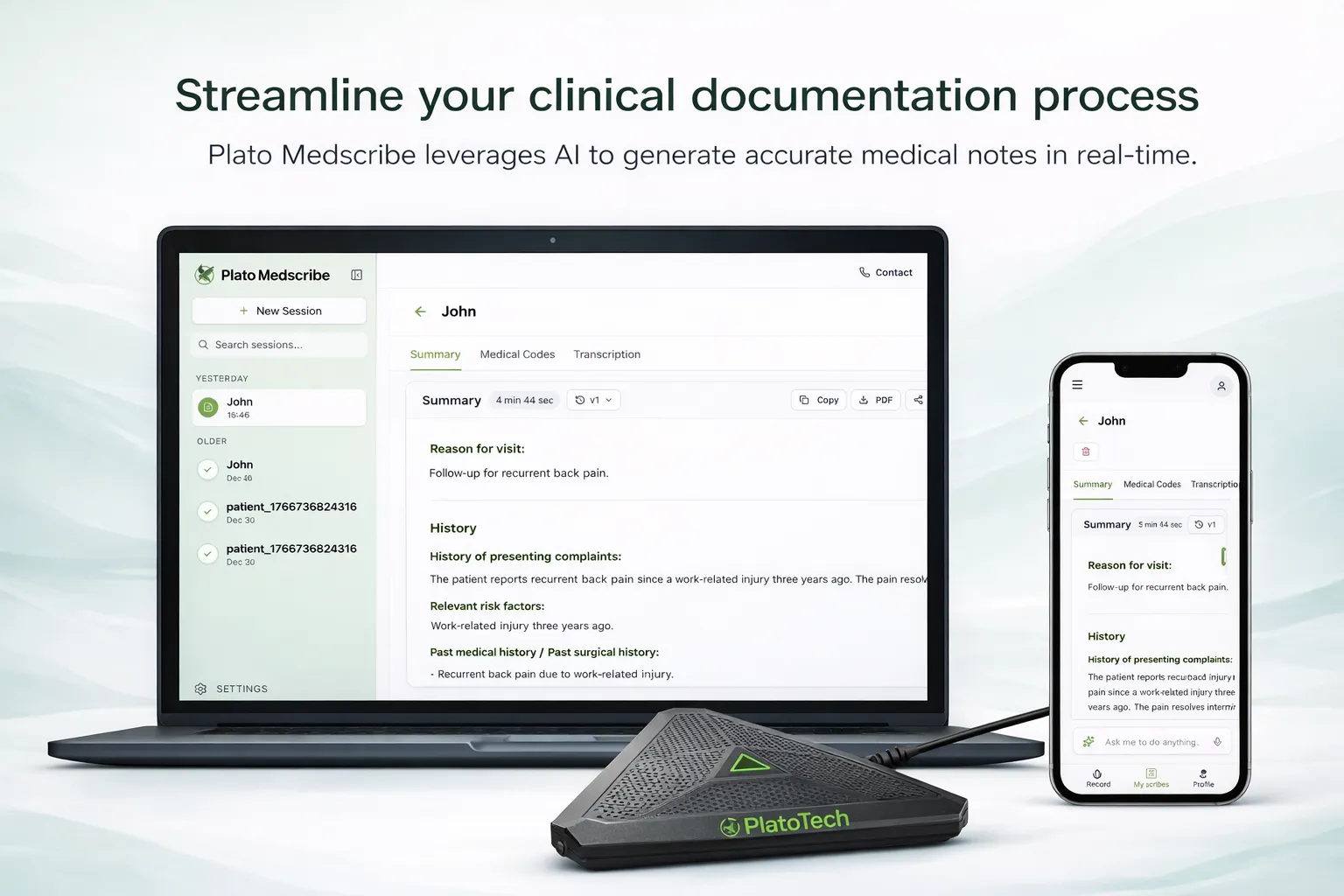
- Audio Capture Quality. Professional-grade hardware that works in real clinical settings. Brilliant AI can't fix poor audio.
- True Multilingual Understanding. Handles Arabic + English medical terminology without requiring slow speech or enunciation.
- Zero-Friction Adoption. Works on your first consultation. No IT projects. No training. Click start, conduct visit, click stop.
- Patient Understanding. 60% of patients forget what the doctor said. Generate plain-language summaries via QR code.
- Regional Compliance Clarity. GDPR, SDAIA, UAE Data Office, PDPA — explicit certifications, not vague HIPAA promises.
✗ What Doesn't Matter
- Fancy Dashboards. You need accurate notes delivered fast, not a 50-tab analytics portal.
- Endless Configuration. Customization sounds appealing until it requires a dedicated staff member.
- '99.9% Accuracy' Claims. Controlled demo accuracy doesn't predict real-world performance.
- Features You'll Never Open. Voice macros, AI differentials, predictive coding — often unused in practice.
The Three Non-Negotiables for Clinics & Hospitals
Based on implementations across 50+ clinics in Dubai, Abu Dhabi, and Riyadh, here are the three requirements your ambient clinical intelligence solution must meet:
- The tool must disappear during the consultation. If your doctor is thinking about the AI scribe instead of the patient, it's failed. The best medical dictation AI is invisible — no laptop barrier, no dictation commands, no disruption to the clinical encounter.
- It must work in real rooms, not demo rooms. Can it handle a consultation in a busy ER with background alarms? A whispered pediatric exam? A surgery with multiple speakers? Test in your actual environment before committing.
- Patients must leave understanding what happened. Documentation isn't just for doctors. The best systems provide patients with clear, accessible summaries they can reference later — ideally via a simple QR code they scan before leaving.
A Short, Honest Comparison of Approaches
Let's compare the main documentation solutions without vendor bias:
| Approach | Benefits | Drawbacks | GCC Reality Check |
|---|---|---|---|
| Manual Entry / Templates | Free, full control, no tech needed | Time-consuming (10+ hrs/week), increases burnout, reduces patient eye contact | Clinicians spend evenings finishing notes |
| Human Scribes | Accurate, understands context, adapts to workflow | Expensive (AED 4-6k/month), scheduling challenges, privacy concerns | Hard to find qualified scribes fluent in Arabic + English medical terminology |
| Traditional Dictation Tools | Faster than typing, works offline | Still requires active dictation, doesn't capture patient conversation, needs heavy editing | Doesn't solve the core problem: doctors still do all the work |
| Ambient AI Transcription | Automatic, affordable, adapts to clinician style, scalable | Quality varies significantly by vendor, requires reliable internet, needs initial trust-building | Best option IF it handles multilingual consultations and noisy environments reliably |
The verdict: For GCC clinics, ambient AI medical scribe software offers the best balance of efficiency, cost, and scalability — but only if it's built for your reality.
How Top AI Medical Scribe Solutions Compare for GCC Clinics
Here's an honest comparison of leading platforms based on actual pilot testing in Dubai, Abu Dhabi, and Riyadh clinics:
Key takeaway: For GCC-based clinics needing Arabic language support, free professional hardware, and region-specific compliance, Plato MedScribe offers capabilities other platforms can't match at this price point.
How Forward-Thinking GCC Clinics Are Piloting AI Scribes Safely
Here's the approach I recommend to hospital administrators and practice owners:
- Start with a small pilot. Three to five clinicians, two weeks maximum. Don't roll out enterprise-wide until you have proof of concept.
- No IT projects. If setup takes more than 15 minutes, you're using the wrong tool. Look for healthcare voice AI that works immediately.
- No workflow changes. Doctors conduct consultations exactly as they normally would. The AI adapts to them, not vice versa.
- Measure time reclaimed, not feature usage. Track one metric: how much earlier do clinicians finish their documentation? Everything else is noise.
- Decide in 14 days. If it's not obviously saving time by day 10, it's not the right solution.
This is exactly how we piloted Plato MedScribe with over 50 clinics across the Emirates. No long-term commitments. No infrastructure projects. Just immediate value.
Key Questions Answered: AI Medical Scribes in the GCC
Here are the questions I hear most frequently from clinicians evaluating virtual medical scribe solutions:
What is an AI medical scribe and how does it work?
An AI medical scribe listens to your consultation in real-time and automatically generates clinical documentation. Unlike dictation software, an ambient AI scribe captures the natural doctor-patient conversation and structures it into a professional note (SOAP, POMR, narrative, etc.). Click 'start', conduct your visit, click 'stop'.
How does ambient documentation reduce doctor burnout?
Physicians spend 15+ hours weekly on documentation — nearly 40% of their work week. Ambient clinical intelligence automates note-taking so clinicians leave on time, maintain eye contact, and focus on clinical decision-making.
How much time can an AI scribe actually save?
GCC pilots show 45-90 minutes saved daily. 20 patients × 5-7 min per note = ~2 hours on docs. A good AI scribe cuts this to under 20 minutes (quick reviews and approvals).
Is AI medical dictation accurate in real settings?
Leading systems achieve 95%+ accuracy in controlled environments. In GCC clinics with multilingual conversations and noise, look for professional recording hardware and AI trained on medical terminology and regional dialects. Always pilot in your actual environment.
Can AI scribes work with Epic, Cerner, and other EHRs?
Yes. Most platforms integrate via APIs or browser extensions. In the GCC where Epic, Cerner, Meditech, and regional systems coexist, flexibility matters more than deep integration with a single platform.
What about data privacy and GDPR compliance?
Ensure: (1) GDPR compliance, (2) SDAIA for Saudi / UAE Data Office for Emirates, (3) Data residency guarantees, (4) Encryption in transit and at rest, (5) No patient audio storage or opt-out capability. Demand certifications, not vague assurances.
How do I choose the right AI scribe solution?
Prioritize: (1) Audio capture quality, (2) True multilingual support, (3) Zero-friction setup, (4) Regional compliance, (5) Patient summaries, (6) Cost & contract flexibility. Run a 2-week pilot. Measure time saved, not features marketed.
The Real Metric That Matters
After evaluating every major player in the AI medical transcription space, here's the insight that changed how I assess these tools:
The best AI medical scribe isn't the smartest one. It's the one clinicians forget is even there.
When you stop thinking about the technology and start thinking about your patients again — that's when you know you've found the right solution.
See How Much Time You Could Save
We've created a simple 60-second assessment that calculates exactly how much time your team could reclaim with ambient clinical documentation — based on your actual patient volume, documentation time, and specialty mix.
Take the Time & Savings Assessment →